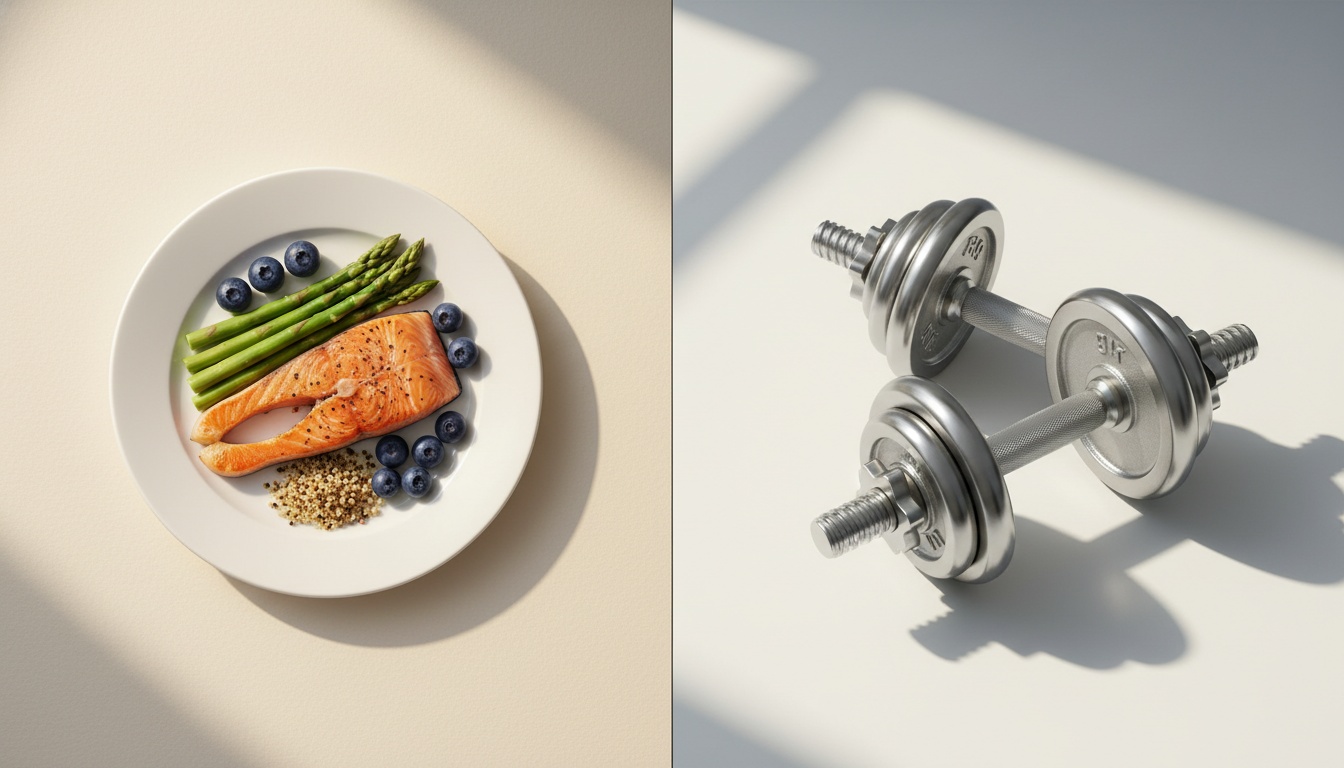
Diet vs exercise for weight loss: what the study actually said
“You can’t outrun a bad diet.” You’ve heard it a thousand times. It’s on every fitness influencer’s page. It’s the default answer when someone asks whether diet or exercise matters more for weight loss.
And it’s partially true. But it’s also dangerously incomplete.
The research says something much more interesting — and much more useful.
What the studies actually show
A 2026 systematic review in PLOS ONE compared diet-only, exercise-only, and combined approaches to weight loss:
- Diet alone: produced the most weight loss on the scale
- Exercise alone: produced less weight loss but more fat loss relative to total weight
- Combined diet + exercise: produced the best outcomes — more weight loss than exercise alone, better body composition than diet alone
The key finding most people miss: exercise doesn’t help you lose weight on the scale as much as diet does. But it changes WHAT you lose.
The muscle problem
Here’s where the “you can’t outrun a bad diet” advice fails:
When you lose weight through diet alone, studies show 25-40% of what you lose is muscle, not fat. Your body breaks down muscle tissue for energy when you’re in a calorie deficit and not giving it a reason to keep the muscle.
When you add resistance training to a calorie deficit, muscle loss drops to 5-15%. You keep more of the tissue that actually burns calories at rest.
Translation: Diet alone makes you lighter but weaker. Diet + exercise makes you lighter AND leaner.
Why exercise matters for hormones
This is the part nobody talks about:
Exercise (especially resistance training) directly improves:
- Insulin sensitivity — your cells respond better to insulin after lifting
- Testosterone — both men and women produce more with regular strength training
- Growth hormone — spikes during and after intense exercise
- Cortisol regulation — regular exercise teaches your body to handle stress better
- Thyroid function — exercise supports the T4 to T3 conversion in your liver
Diet alone can actually worsen some of these:
- Severe calorie restriction lowers testosterone
- Crash diets slow thyroid function
- Under-eating raises cortisol
- Protein deficiency (common in calorie restriction) accelerates muscle loss
You need both. Diet creates the calorie deficit. Exercise preserves the muscle and hormones that make the weight loss sustainable.
The metabolic adaptation trap
When you lose weight through diet alone, your metabolism slows down. This is called metabolic adaptation, and it’s the reason most people regain weight.
Here’s what happens:
- You cut calories → you lose weight
- Your body detects less energy coming in → slows metabolism
- Your body breaks down muscle → metabolism slows further
- You plateau → you cut more calories → the cycle repeats
- You eventually give up → you regain everything + more
Exercise breaks this cycle:
- Resistance training signals your body to keep muscle during a deficit
- More muscle = higher resting metabolic rate
- Higher metabolic rate = you can eat more while maintaining weight
- More food = more sustainable = you don’t give up
What the research says about the ratio
A network meta-analysis published in 2026 found:
- Diet contributes ~75% to weight loss (creating the calorie deficit)
- Exercise contributes ~25% to weight loss (preserving muscle, boosting metabolism)
- But exercise contributes ~80% to weight maintenance (keeping it off long-term)
The paradox: Diet is more important for losing weight. Exercise is more important for keeping it off.
This is why people who only diet regain. And people who only exercise never lose much. You need both, but for different reasons.
The exercise that actually works
Not all exercise is equal for weight loss:
Resistance training (3-4x per week):
- Preserves muscle during calorie deficit
- Improves insulin sensitivity
- Raises resting metabolic rate
- Most important for body composition
Walking (daily):
- Burns calories without spiking cortisol
- Supports digestion and gut health
- Low stress on the body
- Sustainable long-term
HIIT / intense cardio (1-2x per week):
- Burns calories in the moment
- Improves cardiovascular fitness
- BUT: too much raises cortisol, which can stall weight loss
- Not a replacement for resistance training
The minimum effective dose:
- 3 resistance training sessions per week (30-45 minutes)
- 8,000-10,000 steps per day
- That’s it. You don’t need to live in the gym.
What to eat while losing weight
The diet matters. But it’s simpler than most people think:
Protein is non-negotiable. 0.7-1g per pound of body weight. This is the single most important factor for preserving muscle during weight loss.
Calorie deficit of 300-500 calories below maintenance. Not 1,000. Not 1,200. Aggressive deficits cause muscle loss and metabolic slowdown.
Don’t eliminate food groups. Low-fat, low-carb, keto, carnivore — they all work for weight loss if they create a calorie deficit. Pick the one you can sustain.
Eat enough to fuel your training. If you can’t lift heavy because you’re too hungry, your deficit is too aggressive.
The study that changed my mind
A 2026 study in PLOS ONE tracked participants for 12 months:
- Diet-only group: lost 10% body weight, regained 6% within 6 months
- Exercise-only group: lost 4% body weight, kept it all off
- Combined group: lost 12% body weight, kept 95% of it off at 12 months
The combined group lost the most weight AND kept the most weight off. Diet alone produced rapid loss but rapid regain. Exercise alone produced slow loss but perfect maintenance.
The lesson: If you want fast results, diet. If you want permanent results, exercise. If you want both, do both.
The real answer
It’s not diet vs exercise. It’s diet + exercise, for different reasons:
- Diet creates the energy deficit
- Exercise preserves what you want to keep (muscle, hormones, metabolism)
- Together they produce sustainable, lasting weight loss
The people who keep weight off for years aren’t the ones who found the perfect diet. They’re the ones who added exercise to whatever diet they were already doing.
Start with your diet. Add resistance training. Walk daily. That’s the whole formula.
References
Diet vs exercise for weight loss: systematic review and meta-analysis. PLOS ONE. 2026. PubMed
Exercise and metabolic adaptation during weight loss. Obes Facts. 2026. PubMed
Resistance training and body composition during caloric restriction: a meta-analysis. Health Sci Rep. 2026. PubMed
Combined diet and exercise interventions for long-term weight management. Frontiers in Nutrition. 2026. PubMed
Hormonal responses to exercise during energy deficit: implications for weight loss. J Clin Endocrinol Metab. 2026. PubMed
Coming soon:
- Peptides for women over 40: anti-aging, hormones, and fat loss (coming May 18)
- Retatrutide: The next weight loss peptide everyone is waiting for (coming May 20)
- GHK-Cu: The skin peptide that actually works (coming May 22)