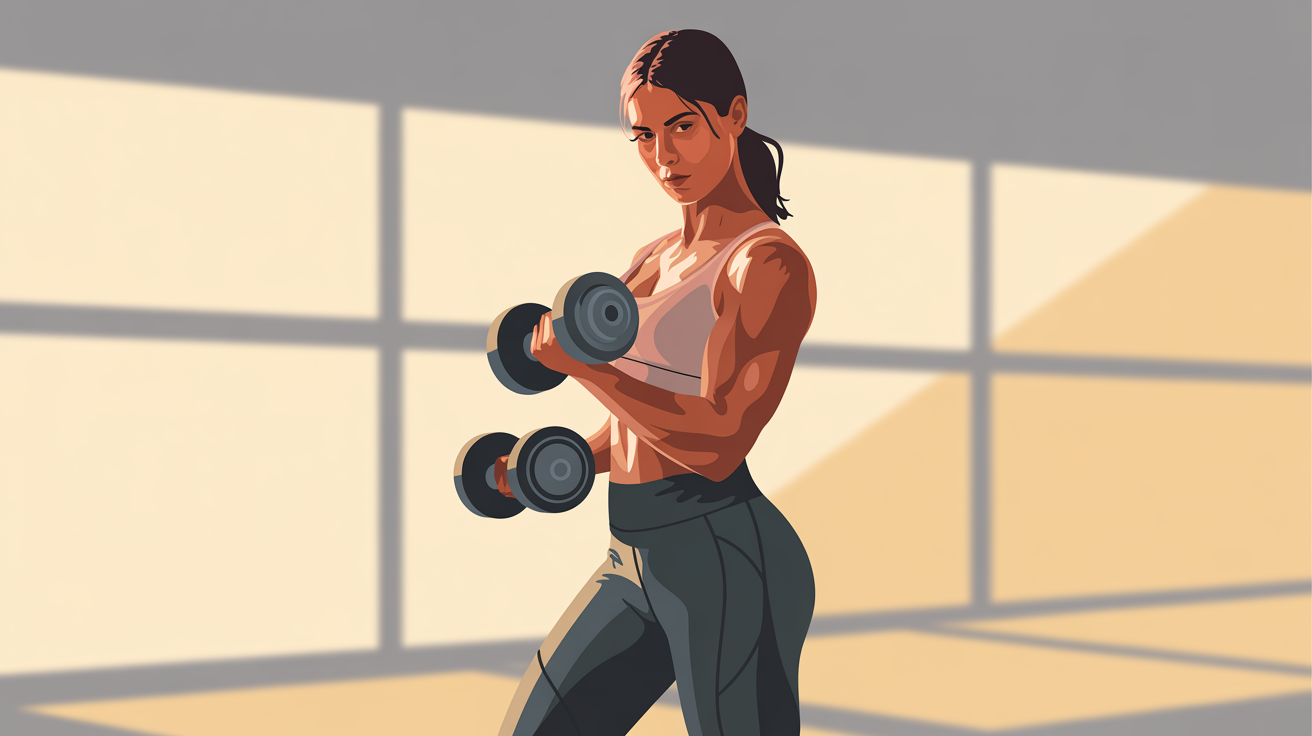
Cardio vs Weights After 40 — Which Changes Your Hormones
You’ve been told to exercise more. Run. Spin. Hit the treadmill. Burn calories.
But after 40, the rules change. What you do in the gym doesn’t just affect your weight — it reshapes your hormones. And the wrong kind of exercise can make your hormonal situation worse, not better.
What happens to your hormones after 40
By your 40s, several hormonal shifts are already underway:
- Testosterone drops — yes, women need testosterone too. By 40, levels have been declining for years. Lower testosterone means less muscle, less energy, less drive.
- Estrogen fluctuates — perimenopause starts years before menopause. Estrogen swings cause weight gain, mood changes, and brain fog.
- Cortisol rises — your stress hormone goes up as your other hormones go down. The body’s natural cortisol buffer (estrogen) is disappearing.
- Growth hormone declines — after 30, you lose about 15% per decade. Less growth hormone means slower recovery, more fat storage, less muscle repair.
- Insulin sensitivity drops — your cells become less responsive to insulin, making weight gain easier and fat loss harder.
These shifts are normal. They’re not optional. What IS optional is how exercise either accelerates or slows them down.
The cardio trap
Here’s what most people over 40 do: they feel heavier, so they do more cardio. Longer runs. More spinning classes. More time on the treadmill.
It feels productive. The scale might even move. But underneath, something else is happening.
Excessive cardio raises cortisol.
Cardio is stress. Your body doesn’t distinguish between running from a lion and running on a treadmill. After 40, when estrogen — your natural cortisol buffer — is declining, that cortisol spike hits harder and lasts longer.
The result:
- More belly fat (cortisol stores fat around the midsection)
- Worse sleep (elevated cortisol disrupts the sleep-wake cycle)
- Lower testosterone (cortisol and testosterone have an inverse relationship — when one goes up, the other goes down)
- More inflammation (chronic cortisol elevation triggers systemic inflammation)
A systematic review in Sports Medicine found that exercise training increases basal levels of testosterone, IGF-1, SHBG, hGH, and DHEA in both men and women over 40 — but the type of exercise matters (Sports Medicine, 2022).
The Society for Endocrinology confirmed that intensified training stress periods of 9-12 days significantly lower testosterone levels — and excess cardio is exactly the kind of stress that triggers this (Society for Endocrinology, 2024).
The bottom line: If you’re running 5x a week and wondering why you’re gaining weight and feeling exhausted, your cortisol is probably the problem.
Why weights win after 40
Resistance training does the opposite of excess cardio for your hormones:
Testosterone and growth hormone spike
Lifting weights — especially compound movements (squats, deadlifts, rows, presses) — triggers acute spikes in testosterone and growth hormone. These spikes don’t turn you into a bodybuilder. They rebuild muscle, strengthen bones, improve mood, and boost energy.
A 20-week trial published in PMC showed that resistance training effectively counteracts age- and menopause-related loss of muscle mass and strength in women aged 40-60 (PMC, 2023).
Bone density improves
Estrogen loss accelerates bone loss after menopause. Strength training is the single most effective way to counteract this — it stimulates osteoblast activity (bone-building cells) and helps maintain skeletal integrity (Princeton Sports Medicine).
Cardio doesn’t do this. Walking doesn’t do this. Only loading the bones with resistance does.
Insulin sensitivity improves
Muscle is your body’s largest glucose sink. More muscle = more places for glucose to go = better insulin sensitivity. Weights build muscle. Cardio burns calories but doesn’t build muscle.
Cortisol normalizes
Unlike hours of cardio, a 45-60 minute strength session produces a manageable cortisol spike that returns to baseline quickly. Your body adapts without chronic stress signaling.
Menopausal symptoms improve
A systematic review found that strength exercises improve menopausal symptoms affecting muscle performance, physical activity, bone density, and hormonal responses — including heart rate, blood pressure, and hot flashes (PMC, 2023).
The ideal split after 40
Here’s what the research supports:
Weights: 3-4x per week (45-60 minutes)
- Compound movements: squats, deadlifts, rows, presses
- Progressive overload: add weight or reps over time
- Full body or upper/lower split
Cardio: 2-3x per week (20-30 minutes)
- Zone 2 (you can hold a conversation)
- Walking, cycling, swimming
- NOT high-intensity every session
Rest: 1-2 days per week
- Your hormones recover during rest, not during training
- Sleep is when growth hormone peaks
The ratio flips what most people think. Weights are the foundation. Cardio is the supplement.
Tools that help
Creatine Monohydrate Powder — the most researched supplement for muscle preservation after 40. 5g daily. Also supports cognitive function and bone density. Not just for gym bros — women over 40 are one of the fastest-growing creatine user groups for a reason.
The bottom line
After 40, your body doesn’t respond to exercise the same way it did at 25. More cardio isn’t better. It’s worse.
Weights rebuild what aging takes away — muscle, bone, testosterone, growth hormone, insulin sensitivity. Cardio burns calories but doesn’t fix the hormonal picture.
The women who age best after 40 aren’t the ones running marathons. They’re the ones lifting heavy.
Coming soon
- Why women need testosterone too (coming May 11) — the hormone everyone thinks is “male only” and why women need it more than they realize
- Peptides: What they are and why everyone is talking about them (coming May 12) — the new frontier in health optimization
- Cortisol: the aging hormone nobody tests for (coming May 30) — why it matters more than you think
This post contains affiliate links. If you purchase through these links, I may earn a small commission at no extra cost to you. I only recommend products I’ve personally tested or that have strong research backing. 👉 Creatine Monohydrate Powder
References:
Effects of Exercise Training on Anabolic and Catabolic Hormones with Advanced Age: A Systematic Review. Sports Medicine (2022). PMC
Overtraining and the Endocrine System. Society for Endocrinology (2024). Article
Resistance Training Alters Body Composition in Middle-Aged Women Depending on Menopause. PMC (2023). PMC
The Science Behind Strength Training for Postmenopausal Women. Princeton Sports Medicine. Article
The Efficacy of Strength Exercises for Reducing the Symptoms of Menopause: A Systematic Review. PMC (2023). PMC